You had a spare room, a basement suite, or maybe a whole property sitting empty, so you listed it on Airbnb.
Smart move. Short-term rentals can generate serious income, and in Canada, the tax rules actually work in your favour – if you know how to use them.
The problem is, most hosts don’t. A few missed steps and you could end up handing a much bigger chunk of that income to CRA than you ever needed to.
Let’s break down what you need to know to stay compliant, claim every deduction you’re entitled to, and keep more money in your pocket.
In this post:
- In Canada, short-term rental income is treated as business income by CRA, which means hosts can deduct a wide range of expenses – but only if their rental is properly licensed.
- Key obligations include registering for GST once revenue exceeds $30,000, understanding the difference between rental and business income, and keeping records that match what platforms like Airbnb report to CRA.
- Hosts in Alberta have additional provincial requirements, including the 4% Tourism Levy and Calgary-specific business licensing rules.
- This article covers the essential tax rules Canadian STR hosts need to know to stay compliant and maximize their deductions.
- Watch the recording of a presentation from live Airbnb meetup in Calgary.
The rule that’s costing hosts the most money
Let’s start with the biggest issue we see.
CRA has a clear rule: if your short-term rental isn’t properly licensed under your local municipal rules, they will deny every single expense deduction you try to claim.
Not reduce them but deny them entirely. That’s the difference between paying tax on your profit and paying tax on your gross revenue.
To put that in real numbers:
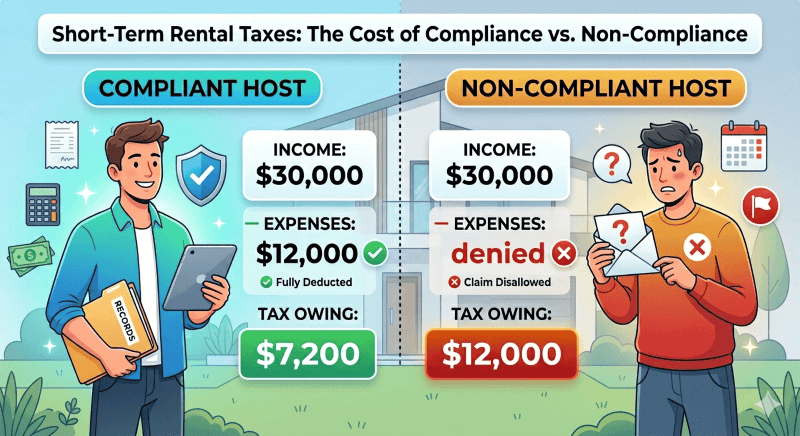
Same income. The only difference is a business license.
And it’s not just about the current year. There’s no statute of limitations on non-compliant years. CRA can reach back and reassess any year where you weren’t properly licensed, indefinitely.
The denial is also pro-rated: if you were unlicensed for part of the year, they’ll disallow expenses proportionally for those days.
Every municipality in Canada handles STR licensing differently – some cities have strict rules, others are more permissive, and some areas have banned short-term rentals altogether (parts of British Columbia, for example).
Whatever the rules are in your city, get licensed and stay licensed. The cost is small compared to what’s at stake.
One more thing: your license number must appear on every listing. Missing it doesn’t just risk your deductions — most municipalities will fine you separately for the omission.
What you can actually deduct
Here’s where running an STR works in your favour. Because short-term rentals are classified as business income, not rental income, you can justify a broader range of deductions than most hosts realize.
The general rule: If you can demonstrate to CRA that an expense was necessary to earn your STR income, it’s deductible.
Common eligible expenses include:
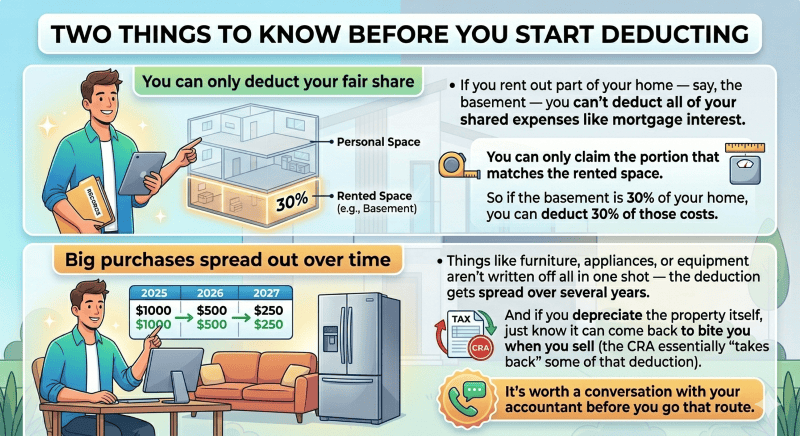
- Mortgage interest (note: the principal repayment portion is not deductible, only the interest)
- Property taxes
- Utilities and home insurance
- Cleaning and maintenance costs
- Airbnb and platform service fees
- Current repairs (not capital improvements, those are treated differently)
- Accounting fees
- Business-related travel, such as attending a conference or STR host event
That last point surprises people. If you travel to attend a short-term rental conference or host meetup, the flight, accommodation, and meals can all be deductible as long as you can demonstrate the business purpose to CRA.
GST registration: when it becomes mandatory
Short-term rentals are treated the same as hotels for GST purposes. Once your STR revenue exceeds $30,000 in a 12-month period, GST registration is mandatory — regardless of which province you’re in.
If you list on Airbnb, the platform will handle GST collection and remittance on bookings made through them once you provide your registration number. But for any direct bookings — guests who contact you off-platform, repeat guests who book privately — collecting and remitting GST is entirely your responsibility.
A trap we see often: a host is already GST-registered but forgets to charge GST on a direct booking. CRA doesn’t care — you still owe it. That 5% comes straight out of your pocket, effectively reducing your revenue on that booking.
Note:
You can register for GST voluntarily before you hit the $30,000 threshold. That would make sense if you’re approaching that number and want to start reclaiming input tax credits on your setup and operating costs.
Rental income vs. business income: why the distinction matters
This is one of the most misunderstood aspects of STR taxation. Short-term rentals are generally treated as business income, not rental income, and that distinction has real consequences in both directions.
On the positive side, it gives you access to a wider range of deductions, and as a sole proprietor it extends your personal tax filing deadline to June 15th (though any taxes owing are still due April 30th).
The flip side: if you offer hotel-style services such as daily cleaning, meals, concierge, CRA may reclassify your income in a way that adds CPP obligations and increases your audit exposure. The more your STR operates like a hotel, the more it gets treated like one.

What CRA is actively watching
CRA has been increasingly targeting short-term rental platforms, requesting income data directly from Airbnb and similar services. In many cases, they know what you earned before you even file. If what appears on your return doesn’t match the platform data, that mismatch is one of the most common triggers for a review or audit.
Other things they’re looking at:
- Whether your platform-reported income matches your filed return
- Whether your license number appears on your active listings
- Unusual expense patterns – a sudden spike in legal fees, for example, is almost guaranteed to attract attention
- Whether applicable tourism or accommodation levy filings are current
- Hosts whose annual revenue is hovering near the $30,000 GST threshold
The practical takeaway: The more organized your records are upfront (receipts, invoices, platform statements) the smoother any CRA review will be. Good documentation is your best defense.

Short-term Rentals in Alberta - What's different
Most of what’s covered above applies across Canada. But if you’re hosting in Alberta, and particularly in Calgary, there are a few province and city-specific rules worth knowing.
The Alberta Tourism Levy
Alberta charges a 4% Tourism Levy on short-term stays under 30 days. If you book exclusively through Airbnb, the platform typically handles collection and remittance for you. But the moment you take a direct booking, that responsibility is yours — you need to collect the levy and remit it to the Alberta government directly. We’ve seen hosts with clean Airbnb records who completely overlooked this on their direct bookings.
Calgary Business Licencing
In Calgary, running an STR requires an active Calgary short-term rental business licence. The cost is relatively modest ($286 for a primary residence, $624 for an investment or non-primary property) but the consequences of skipping it are significant. CRA will deny all your expense deductions for any period you were unlicensed, and they can go back indefinitely. Your licence number must also appear on every listing; missing it triggers a $1,000 municipal fine.
Calgary defines an STR as any rental up to 180 days, which means mid-term rentals are included under the same rules. CRA’s own definition is under 90 days — and both definitions apply independently of each other.
Alberta Tax Rates And The Corporation Question
Short-term rental income is classified as active income in Canada, which opens up an interesting option for Alberta hosts. Alberta’s small business corporate tax rate is just 11% on the first $500,000 of income => compare that to personal marginal rates that can reach 48% in this province, and the potential tax saving is significant.
That said, incorporating isn’t right for everyone. The savings really kick in when you’re leaving earnings inside the corporation rather than withdrawing them immediately. If you’re pulling all your profit out each year, the additional compliance costs – corporate filings, bookkeeping – can eat up most of the benefit. This is a conversation worth having with your accountant once your STR income reaches a meaningful level.
have questions about your short-term rental taxes?
RMI’s team works with short-term rental hosts across Calgary and Alberta.
Book a consultation with us today or contact us at 403-457-4232 or info@rmillp.com.